KI-generert løsningsforslag. Dette løsningsforslaget er skrevet av en språkmodell (Claude) og er ikke verifisert av lærer. Det kan inneholde regnefeil, upresis bruk av begreper eller mangler.
a)
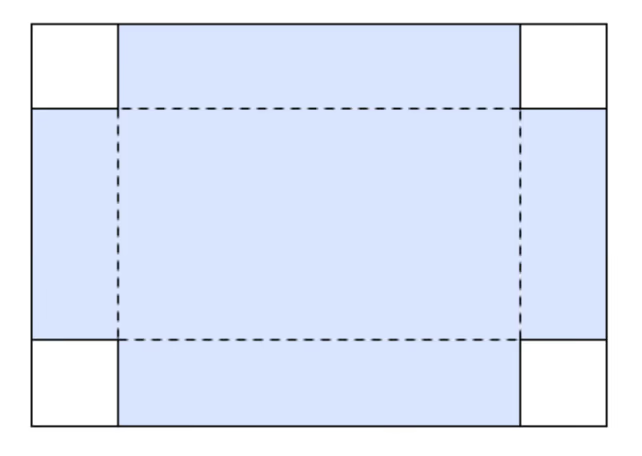
Når vi klipper bort et kvadrat med side x x x i hvert hjørne og bretter opp, får esken:
Høyde: x c m x \, \mathrm{cm} x cm (siden vi bretter opp)
Lengde: ( 20 − 2 x ) c m (20 - 2x) \, \mathrm{cm} ( 20 − 2 x ) cm (vi mister x x x i hver ende)
Bredde: ( 14 − 2 x ) c m (14 - 2x) \, \mathrm{cm} ( 14 − 2 x ) cm (vi mister x x x i hver ende)
Volum: V = x ⋅ ( 20 − 2 x ) ⋅ ( 14 − 2 x ) c m 3 V = x \cdot (20-2x) \cdot (14-2x) \, \mathrm{cm^3} V = x ⋅ ( 20 − 2 x ) ⋅ ( 14 − 2 x ) c m 3
Vi fyller inn tabellen rad for rad:
Rad 1: x = 4 c m x = 4 \, \mathrm{cm} x = 4 cm (volumet er oppgitt som 288 c m 3 288 \, \mathrm{cm^3} 288 c m 3 , vi regner ut de andre):
Lengde = 20 − 2 ⋅ 4 = 12 c m , Bredde = 14 − 2 ⋅ 4 = 6 c m , Høyde = 4 c m \text{Lengde} = 20 - 2 \cdot 4 = 12 \, \mathrm{cm}, \quad \text{Bredde} = 14 - 2 \cdot 4 = 6 \, \mathrm{cm}, \quad \text{Høyde} = 4 \, \mathrm{cm} Lengde = 20 − 2 ⋅ 4 = 12 cm , Bredde = 14 − 2 ⋅ 4 = 6 cm , Høyde = 4 cm
V = 12 ⋅ 6 ⋅ 4 = 288 c m 3 ✓ V = 12 \cdot 6 \cdot 4 = 288 \, \mathrm{cm^3} \checkmark V = 12 ⋅ 6 ⋅ 4 = 288 c m 3 ✓
Rad 2: x = 3 c m x = 3 \, \mathrm{cm} x = 3 cm (bredden er oppgitt som 8 c m 8 \, \mathrm{cm} 8 cm ):
Lengde = 20 − 2 ⋅ 3 = 14 c m , Bredde = 8 c m ✓ , Høyde = 3 c m \text{Lengde} = 20 - 2 \cdot 3 = 14 \, \mathrm{cm}, \quad \text{Bredde} = 8 \, \mathrm{cm} \checkmark, \quad \text{Høyde} = 3 \, \mathrm{cm} Lengde = 20 − 2 ⋅ 3 = 14 cm , Bredde = 8 cm ✓ , Høyde = 3 cm
V = 14 ⋅ 8 ⋅ 3 = 336 c m 3 V = 14 \cdot 8 \cdot 3 = 336 \, \mathrm{cm^3} V = 14 ⋅ 8 ⋅ 3 = 336 c m 3
Rad 3: x = 2,5 c m x = 2{,}5 \, \mathrm{cm} x = 2 , 5 cm :
Lengde = 20 − 2 ⋅ 2,5 = 15 c m , Bredde = 14 − 2 ⋅ 2,5 = 9 c m , Høyde = 2,5 c m \text{Lengde} = 20 - 2 \cdot 2{,}5 = 15 \, \mathrm{cm}, \quad \text{Bredde} = 14 - 2 \cdot 2{,}5 = 9 \, \mathrm{cm}, \quad \text{Høyde} = 2{,}5 \, \mathrm{cm} Lengde = 20 − 2 ⋅ 2 , 5 = 15 cm , Bredde = 14 − 2 ⋅ 2 , 5 = 9 cm , Høyde = 2 , 5 cm
V = 15 ⋅ 9 ⋅ 2,5 = 337,5 c m 3 V = 15 \cdot 9 \cdot 2{,}5 = 337{,}5 \, \mathrm{cm^3} V = 15 ⋅ 9 ⋅ 2 , 5 = 337 , 5 c m 3
Rad 4: x c m x \, \mathrm{cm} x cm (generelt):
Lengde = ( 20 − 2 x ) c m , Bredde = ( 14 − 2 x ) c m , Høyde = x c m \text{Lengde} = (20-2x) \, \mathrm{cm}, \quad \text{Bredde} = (14-2x) \, \mathrm{cm}, \quad \text{Høyde} = x \, \mathrm{cm} Lengde = ( 20 − 2 x ) cm , Bredde = ( 14 − 2 x ) cm , Høyde = x cm
V = x ( 20 − 2 x ) ( 14 − 2 x ) c m 3 V = x(20-2x)(14-2x) \, \mathrm{cm^3} V = x ( 20 − 2 x ) ( 14 − 2 x ) c m 3
Utfylt tabell:
Side i kvadrat Lengde Bredde Høyde Volum 4 c m 4 \, \mathrm{cm} 4 cm 12 c m 12 \, \mathrm{cm} 12 cm 6 c m 6 \, \mathrm{cm} 6 cm 4 c m 4 \, \mathrm{cm} 4 cm 288 c m 3 288 \, \mathrm{cm^3} 288 c m 3 3 c m 3 \, \mathrm{cm} 3 cm 14 c m 14 \, \mathrm{cm} 14 cm 8 c m 8 \, \mathrm{cm} 8 cm 3 c m 3 \, \mathrm{cm} 3 cm 336 c m 3 336 \, \mathrm{cm^3} 336 c m 3 2,5 c m 2{,}5 \, \mathrm{cm} 2 , 5 cm 15 c m 15 \, \mathrm{cm} 15 cm 9 c m 9 \, \mathrm{cm} 9 cm 2,5 c m 2{,}5 \, \mathrm{cm} 2 , 5 cm 337,5 c m 3 337{,}5 \, \mathrm{cm^3} 337 , 5 c m 3 x c m x \, \mathrm{cm} x cm ( 20 − 2 x ) c m (20-2x) \, \mathrm{cm} ( 20 − 2 x ) cm ( 14 − 2 x ) c m (14-2x) \, \mathrm{cm} ( 14 − 2 x ) cm x c m x \, \mathrm{cm} x cm x ( 20 − 2 x ) ( 14 − 2 x ) c m 3 x(20-2x)(14-2x) \, \mathrm{cm^3} x ( 20 − 2 x ) ( 14 − 2 x ) c m 3
b)
Vi har volumfunksjonen
V ( x ) = x ( 20 − 2 x ) ( 14 − 2 x ) V(x) = x(20-2x)(14-2x) V ( x ) = x ( 20 − 2 x ) ( 14 − 2 x )
der x x x må være mellom 0 0 0 og 7 7 7 (ellers blir bredden 14 − 2 x 14-2x 14 − 2 x negativ).
Vi ganger ut parentesene:
V ( x ) = 4 x 3 − 68 x 2 + 280 x V(x) = 4x^3 - 68x^2 + 280x V ( x ) = 4 x 3 − 68 x 2 + 280 x
For å finne maksimum deriverer vi og setter V ′ ( x ) = 0 V'(x) = 0 V ′ ( x ) = 0 :
V ′ ( x ) = 12 x 2 − 136 x + 280 V'(x) = 12x^2 - 136x + 280 V ′ ( x ) = 12 x 2 − 136 x + 280
12 x 2 − 136 x + 280 = 0 12x^2 - 136x + 280 = 0 12 x 2 − 136 x + 280 = 0
Vi deler alle ledd på 4 4 4 :
3 x 2 − 34 x + 70 = 0 3x^2 - 34x + 70 = 0 3 x 2 − 34 x + 70 = 0
Løsning med a b c abc ab c -formelen (a = 3 a=3 a = 3 , b = − 34 b=-34 b = − 34 , c = 70 c=70 c = 70 ):
x = 34 ± 34 2 − 4 ⋅ 3 ⋅ 70 2 ⋅ 3 = 34 ± 1156 − 840 6 = 34 ± 316 6 x = \frac{34 \pm \sqrt{34^2 - 4 \cdot 3 \cdot 70}}{2 \cdot 3} = \frac{34 \pm \sqrt{1156 - 840}}{6} = \frac{34 \pm \sqrt{316}}{6} x = 2 ⋅ 3 34 ± 3 4 2 − 4 ⋅ 3 ⋅ 70 = 6 34 ± 1156 − 840 = 6 34 ± 316
316 ≈ 17,78 \sqrt{316} \approx 17{,}78 316 ≈ 17 , 78
x 1 = 34 − 17,78 6 ≈ 16,22 6 ≈ 2,70 c m x_1 = \frac{34 - 17{,}78}{6} \approx \frac{16{,}22}{6} \approx 2{,}70 \, \mathrm{cm} x 1 = 6 34 − 17 , 78 ≈ 6 16 , 22 ≈ 2 , 70 cm
x 2 = 34 + 17,78 6 ≈ 51,78 6 ≈ 8,63 c m x_2 = \frac{34 + 17{,}78}{6} \approx \frac{51{,}78}{6} \approx 8{,}63 \, \mathrm{cm} x 2 = 6 34 + 17 , 78 ≈ 6 51 , 78 ≈ 8 , 63 cm
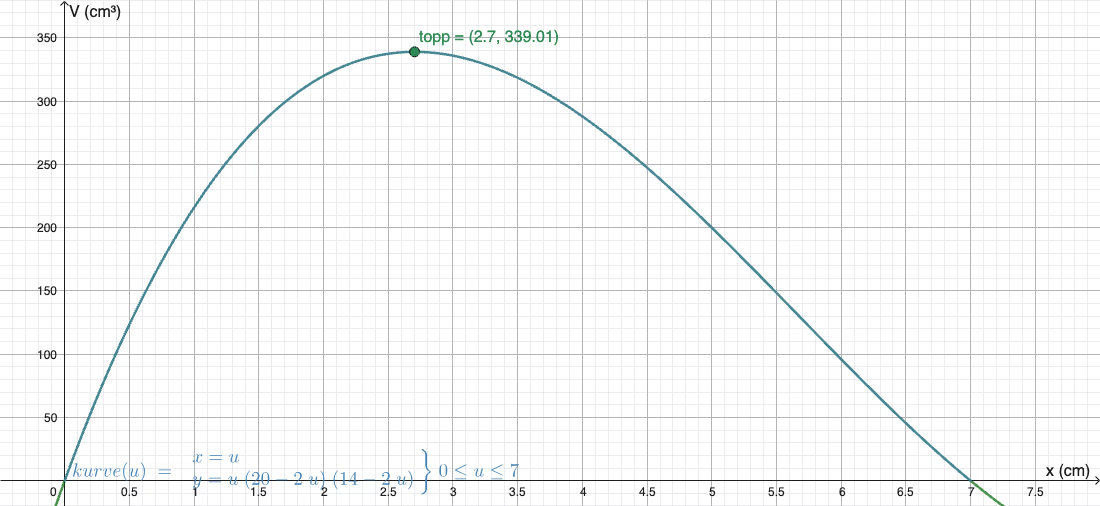
Siden x x x må være mellom 0 0 0 og 7 7 7 , er det bare x ≈ 2,70 x \approx 2{,}70 x ≈ 2 , 70 som er gyldig.
Vi kontrollerer at det er et maksimum (og ikke minimum) ved å sjekke andrederiverte:
V ′ ′ ( x ) = 24 x − 136 V''(x) = 24x - 136 V ′′ ( x ) = 24 x − 136
V ′ ′ ( 2,70 ) = 24 ⋅ 2,70 − 136 = 64,8 − 136 = − 71,2 < 0 ✓ V''(2{,}70) = 24 \cdot 2{,}70 - 136 = 64{,}8 - 136 = -71{,}2 < 0 \checkmark V ′′ ( 2 , 70 ) = 24 ⋅ 2 , 70 − 136 = 64 , 8 − 136 = − 71 , 2 < 0 ✓
Negativt fortegn bekrefter at det er et toppunkt.
Maksimalt volum:
V ( 2,70 ) = 2,70 ⋅ ( 20 − 2 ⋅ 2,70 ) ⋅ ( 14 − 2 ⋅ 2,70 ) = 2,70 ⋅ 14,60 ⋅ 8,60 ≈ 339 c m 3 V(2{,}70) = 2{,}70 \cdot (20 - 2 \cdot 2{,}70) \cdot (14 - 2 \cdot 2{,}70) = 2{,}70 \cdot 14{,}60 \cdot 8{,}60 \approx 339 \, \mathrm{cm^3} V ( 2 , 70 ) = 2 , 70 ⋅ ( 20 − 2 ⋅ 2 , 70 ) ⋅ ( 14 − 2 ⋅ 2 , 70 ) = 2 , 70 ⋅ 14 , 60 ⋅ 8 , 60 ≈ 339 c m 3
Sidene i de utkleipte kvadratene bør være omtrent x ≈ 2,70 c m ‾ ‾ \underline{\underline{x \approx 2{,}70 \, \mathrm{cm}}} x ≈ 2 , 70 cm . Da blir volumet størst mulig med V ≈ 339 c m 3 ‾ ‾ \underline{\underline{V \approx 339 \, \mathrm{cm^3}}} V ≈ 339 c m 3 .